
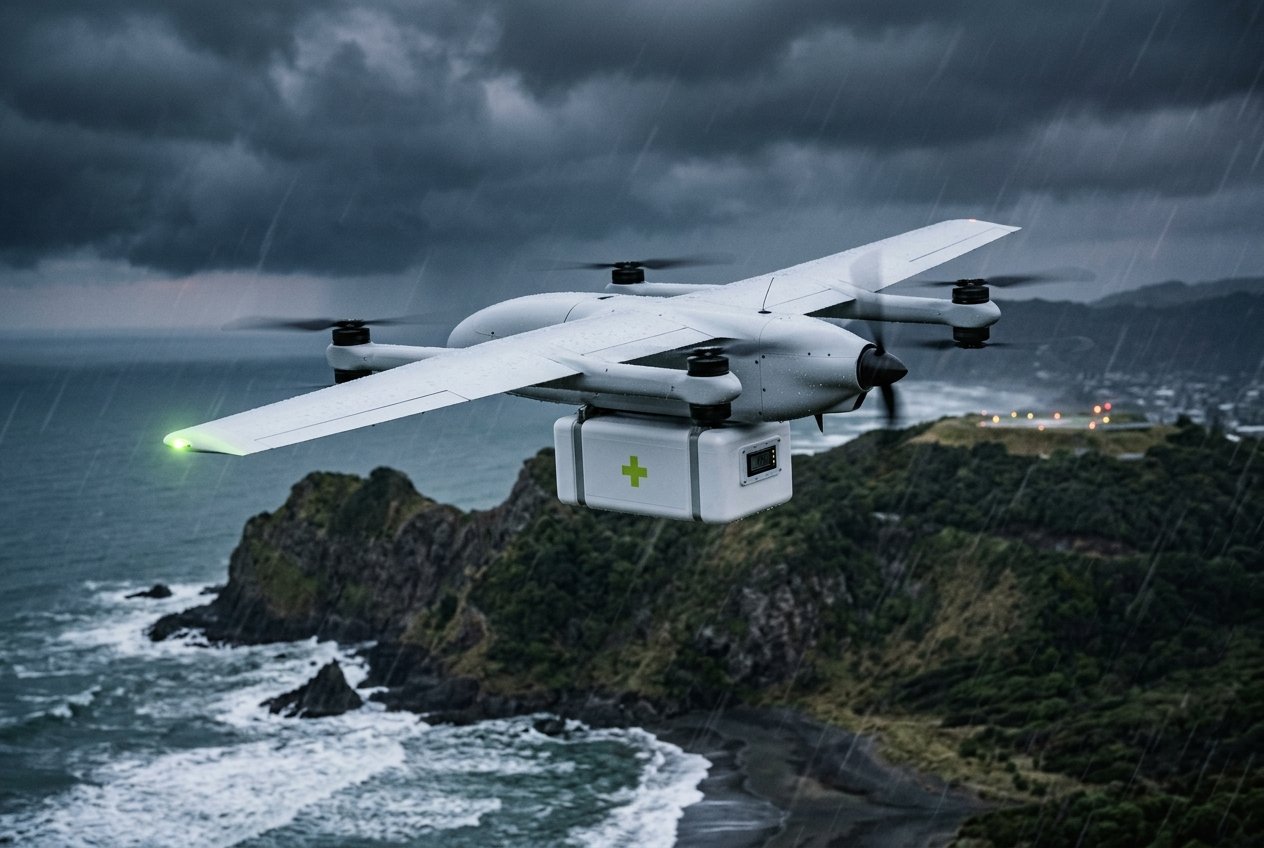
Autonomous VTOL drone carrying a sealed medical payload through storm conditions over the Northland coast
◉ Mission · Pathology corridor
Payload 2–8 °C · Sealed
WX: Rain · 28 kt gusts · GO

Use case · Medical logistics · Northland → Auckland

Pathology thatdoesn't wait for weather.

An autonomous BVLOS corridor moving blood samples from Northland hospitals to Auckland laboratories — flown through the Tasman fronts and highway closures that stall road couriers. Two proven medical-logistics airframes, one chain of custody, results the same day.

Trunk corridor

≈130 km

Whangārei Hospital → Auckland labs

Hub-to-lab

≈70 min

KITE at 115 km/h cruise

Wind limit

35 kt

KITE hover & cruise · 18 m/s

Cold chain

2–8 °C

Logged payload temperature

Packaging

UN3373

Category B · IATA PI 650

◇ Mission profile

Three legs. Oneunbroken custody.

Hub-and-spoke: short tilt-rotor legs feed a Whangārei hub; a long-range fixed-wing VTOL flies the trunk to Auckland. Road courier for the same job: 2.5–4 hours door-to-door, subject to SH1 closures.

LEG 01

Regional spokes

Bay of Islands Hospital (Kawakawa) · Dargaville Hospital → Whangārei Hospital

Tilt-rotor legs under 50 km collect sealed sample boxes from regional hospital pads and winch them onto the Whangārei hub pad without landing. Hot-swap batteries at each pad keep the aircraft cycling through the day.
Wingcopter 198

≈45 km each

≈30 min

LEG 02

Trunk corridor

Whangārei Hospital → Auckland laboratory network

Consolidated samples fly the long-haul leg on a fixed-wing VTOL with 240 km one-way range, SATCOM + LTE command links and a 35 kt wind limit. Return flights backhaul reagents, blood products and urgent pharmacy items.
KITE

≈130 km

≈70 min

LEG 03

Handover & custody

Laboratory receipt → results

Pad-to-bench handover scans the sealed container, exports the temperature log and closes the chain-of-custody record. Lab staff see the manifest before the aircraft lands.
Digital manifest

—

< 5 min

◇ The aircraft

Two airframes,matched to the leg.

Manufacturer-published specifications. Both platforms carry operational pedigrees in medical delivery networks and both are flown under our CAA Part 102 exposition.

▸ A-01 · Kite Aero

Trunk corridor

KITE

Fixed-wing VTOL · Powered-lift eVTOL

Port Melbourne, Australia · built in Geelong

A modular, fully-redundant long-range logistics aircraft with a 36,000+ flight operational legacy in medical networks across Africa, Europe and the US. Internal pass-through payload bay with top and bottom access for dispatch, drop or winch delivery. Fleet operations run on the AXIOM operating system — one pilot, multiple aircraft, every route auto-checked before flight.

240 km

One-way range · 2.5 kg

115 km

Return range · 2.5 kg

4 kg

Max payload

115 km/h

Cruise speed

200 km/h

Max speed

18 m/s · 35 kt

Wind limit (hover & cruise)

Light rain 2 mm/hr · no icing

Weather

−5 °C to 45 °C

Operating temp

SATCOM + LTE

Command & control

26.5 kg

MTOW

250 × 125 × 205 mm

Payload bay

2.72 m

Wingspan

◇ Mission role · Whangārei → Auckland long haul

  • Fully-electric, fully-redundant powertrain — no single point of failure
  • Internal payload bay: dispatch, drop or winch
  • Altitude limit 3,000 m AMSL · in-field maintenance, aviation-grade practices
  • Powered by AXIOM: many-to-one pilot operations, 100% of routes auto-checked
Manufacturer specification · kite.aero · KITE spec sheet

▸ A-02 · Wingcopter

Regional spokes

Wingcopter 198

Electric tilt-rotor eVTOL

Weiterstadt, Germany

A compact tilt-rotor built for logistics and LiDAR work, with a fail-safe powertrain of eight motors, eight ESCs and two batteries plus redundant airspeed, heading and positioning sensors. Its patented tilt-rotor design holds station in strong wind for winch delivery, so regional hospitals need a marked pad — not a runway or a landing crew.

94 km

Max range

4.7 kg

Payload

90 km/h

Cruise speed

15 m/s · gusts 20 m/s

Wind resistance

Moderate rain to 12.7 mm/hr · no icing

Weather

25 kg

MTOW

198 × 152 × 65 cm

Dimensions

8 motors · 8 ESCs · 2 batteries

Powertrain

Winch from hover · Triple-Drop

Delivery

22 × 40 × 65 cm

Package (single)

Hot-swap smart packs

Batteries

Designed for Level 4

Autonomy

◇ Mission role · Hospital pad winch delivery · < 50 km legs

  • Redundant flight control: dual airspeed, dual heading & positioning
  • Fail-safe powertrain — flies on after a motor or battery failure
  • Triple-Drop: up to three packages to three pads in one flight
  • Component performance data uploaded to a maintenance database — no unplanned downtime
Manufacturer specification · wingcopter.com · Wingcopter 198

◇ Harsh-weather doctrine

Built for Northlandweather, not around it.

Wind

Northland's Tasman fronts routinely gust past 30 kt. Each leg carries its own wind ceiling — 35 kt for KITE, 15 m/s sustained for the Wingcopter — checked against live METAR and model winds before every launch.

Live preflight check

Rain

Per-aircraft rain limits (2 mm/hr KITE · 12.7 mm/hr Wingcopter 198) drive the go/no-go matrix. Sample boxes are sealed and insulated; the aircraft, not the payload, is the limiting factor.

Icing & temperature

Corridors are flown low — under 400 ft AGL — inside both airframes' −5 °C to 45 °C envelopes. No icing conditions are accepted; winter dawn launches are held until the freezing level clears.

Diversions

Geofenced corridors with pre-surveyed alternate pads every 25–35 km. A degraded link, battery or weather trigger diverts the aircraft to the nearest safe pad with the sample still in custody.

Airspace & corridors

◇ For hospital & procurement leads

What changeson the ward.

Same-day results for regional patients

Samples drawn in Kawakawa or Dargaville in the morning are on an Auckland bench before lunch — instead of overnight.

Immune to SH1 closures

When the Brynderwyn Hills or a slip closes the highway, the corridor keeps flying over it. No detours, no stranded couriers.

Predictable scheduling

Timetabled rotations plus on-demand STAT flights give clinicians a known turnaround to plan treatment around.

Fewer repeat draws

Shorter transit and logged temperatures mean fewer haemolysed or out-of-range samples rejected at the lab.

◉ Safety & assurance stack

Regulatory
CAA Part 102 exposition · BVLOS approvals built route by route
Packaging
UN3373 Category B biological substances · IATA PI 650 triple packaging
Cold chain
2–8 °C validated containers with continuous data loggers
Redundancy
Redundant powertrains, sensors and command links on both airframes
Custody
Sealed, scanned, time-stamped — digital manifest from draw to bench
Privacy
No patient identifiers on exterior labels · encrypted manifests

Proposed mission profile. Aircraft figures are manufacturer-published; corridor timings derived from published cruise speeds and great-circle distances. Route approvals are obtained per corridor under our Part 102 exposition.

◉ Pilot programme briefings available for DHB / Te Whatu Ora districts

Request a corridor briefing